🫀 ANATOMY
Larynx Anatomy Functions Nerve Supply Muscles Cartilages Clinical Importance
Complete detailed guide on larynx anatomy including cartilages, muscles, nerve supply, blood supply, cavity, functions, development and applied clinical anatomy explained clearly for medical and nursing students.
Choose Your Mode
How do you want to practice?
Study Mode
Learn at your own pace. Get instant feedback and detailed explanations after each question.
Start Studying
Exam Mode
Simulate real exam conditions. Timed questions, full scoring, and performance breakdown.
Take Exam
Strict Exam
Maximum difficulty. Full-screen, no backtracking, strict timing. For serious preparation.
Frequently Asked Questions
❓ What is the larynx?
The larynx is a hollow fibrocartilaginous organ of the upper respiratory tract located between the pharynx and trachea. It plays a key role in phonation, respiration, and protection of the lower airway.
❓ At which vertebral levels is the larynx located?
The larynx extends from the level of the C3 to C6 vertebrae in adults.
❓ What are the main functions of the larynx?
The main functions of the larynx are voice production, maintenance of a patent airway for breathing, prevention of aspiration during swallowing, and initiation of the cough reflex.
❓ How many cartilages form the larynx?
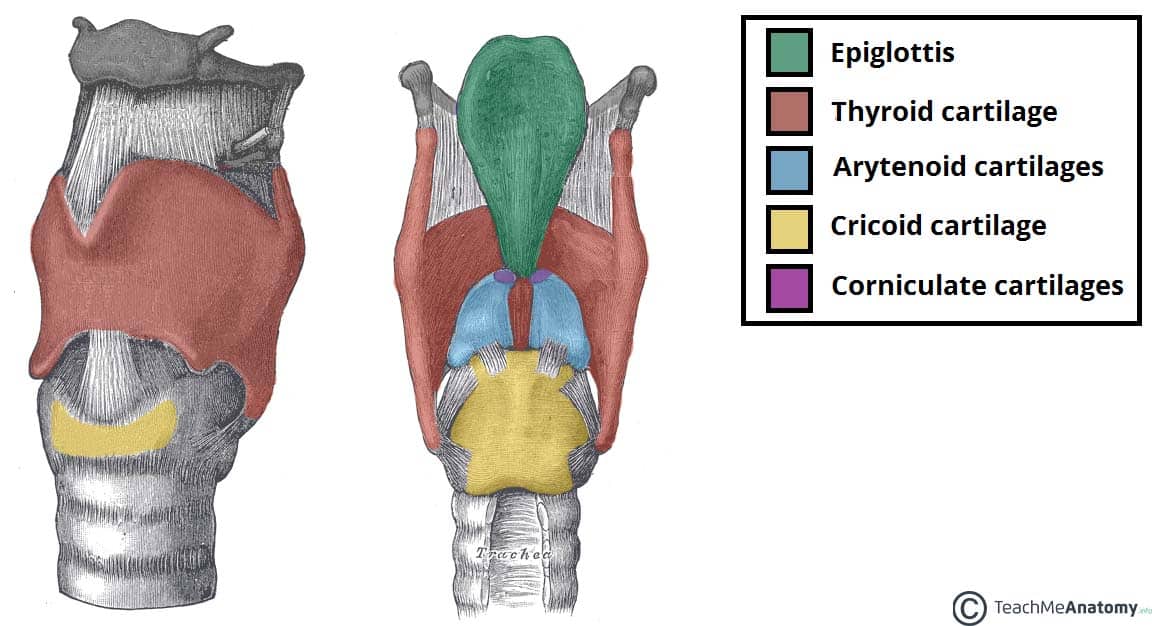
The larynx is formed by nine cartilages: three unpaired (thyroid, cricoid, epiglottis) and three paired (arytenoid, corniculate, and cuneiform).
❓ Which cartilage forms a complete ring in the larynx?
The cricoid cartilage is the only laryngeal cartilage that forms a complete ring around the airway.
❓ What are the main parts of the laryngeal cavity?
The laryngeal cavity is divided into the vestibule, ventricle, and infraglottic cavity.
❓ What is the difference between true and false vocal cords?
True vocal cords are involved in phonation and contain the vocal ligament, while false vocal cords (vestibular folds) are primarily protective and do not produce sound.
❓ Which muscle is the only abductor of the vocal cords?
The posterior cricoarytenoid muscle is the only muscle that abducts the vocal cords.
❓ What is the nerve supply of the larynx?
Motor supply is mainly by the recurrent laryngeal nerve, except the cricothyroid muscle which is supplied by the external laryngeal nerve. Sensory supply above the vocal cords is via the internal laryngeal nerve and below the cords via the recurrent laryngeal nerve.
❓ What is the function of the epiglottis?
The epiglottis prevents food and liquids from entering the larynx during swallowing by directing them toward the esophagus.
❓ Why do vocal cord tumors present early with hoarseness?
Vocal cord tumors affect cord vibration even when small, leading to early hoarseness due to disruption of normal phonation.
❓ What is the clinical importance of the cricothyroid membrane?
The cricothyroid membrane is the preferred site for emergency airway access during cricothyrotomy.
❓ What happens in unilateral recurrent laryngeal nerve injury?
Unilateral recurrent laryngeal nerve injury typically causes hoarseness of voice due to paralysis of one vocal cord.
❓ What happens in bilateral recurrent laryngeal nerve injury?
Bilateral injury causes paralysis of both vocal cords in a near-midline position, leading to severe airway obstruction and stridor.
❓ Why is lymphatic spread limited in glottic cancers?
Glottic cancers spread late because the true vocal cords have very poor lymphatic drainage.