📋 Paediatrics
Neonatal Resuscitation Guide for Newborn Emergency Care
Learn neonatal resuscitation step by step with complete NRP guidelines, ventilation, chest compressions, emergency drugs, airway management, and post-resuscitation care for newborns.
Choose Your Mode
How do you want to practice?
Study Mode
Learn at your own pace. Get instant feedback and detailed explanations after each question.
Start Studying
Exam Mode
Simulate real exam conditions. Timed questions, full scoring, and performance breakdown.
Take Exam
Strict Exam
Maximum difficulty. Full-screen, no backtracking, strict timing. For serious preparation.
Frequently Asked Questions
❓ What is neonatal resuscitation?
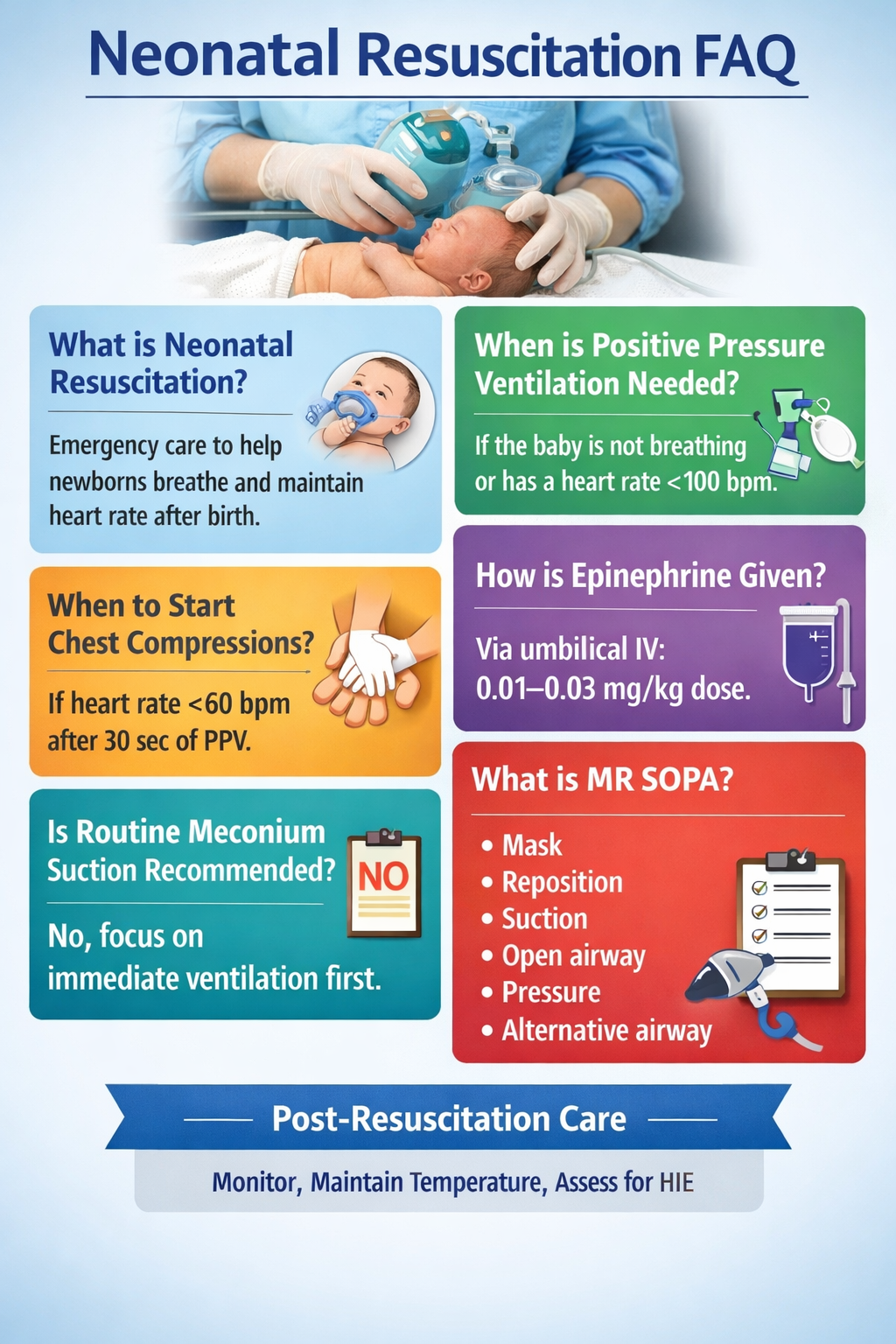
Neonatal resuscitation is a set of immediate interventions provided to a newborn after birth to establish effective breathing, adequate heart rate, and proper oxygenation when normal transition fails.
❓ How many newborns require resuscitation at birth?
About 10% of newborns require some assistance at birth, while approximately 1% need extensive resuscitation including chest compressions or medications.
❓ What is the most important step in neonatal resuscitation?
Effective ventilation is the most critical step, as most neonatal cardiac compromise is secondary to inadequate oxygenation and ventilation.
❓ When should positive pressure ventilation be started in a newborn?
Positive pressure ventilation should be started if the newborn is apneic, gasping, or has a heart rate less than 100 beats per minute after initial stabilization.
❓ What heart rate indicates the need for chest compressions in neonatal resuscitation?
Chest compressions are indicated when the heart rate remains below 60 beats per minute despite at least 30 seconds of effective positive pressure ventilation.
❓ What is the correct compression-to-ventilation ratio in neonatal CPR?
The recommended ratio is 3 compressions to 1 ventilation, resulting in 90 compressions and 30 breaths per minute.
❓ When is epinephrine indicated during neonatal resuscitation?
Epinephrine is indicated if the heart rate remains below 60 beats per minute despite effective ventilation and coordinated chest compressions.
❓ What is the preferred route for epinephrine administration in newborns?
The preferred route is intravenous administration via an umbilical venous catheter, as it provides the fastest and most reliable effect.
❓ What oxygen concentration should be used initially for term newborn resuscitation?
Term newborns should be started on room air (21% oxygen), with oxygen concentration titrated based on pulse oximetry targets.
❓ How does neonatal resuscitation differ in preterm infants?
Preterm infants require careful temperature control, lower initial oxygen concentration (21–30%), gentle ventilation strategies, and may benefit from early CPAP.
❓ Is routine suctioning recommended for babies born through meconium-stained amniotic fluid?
No, routine suctioning is not recommended. Ventilation should be prioritized unless there is clear airway obstruction.
❓ What is MR SOPA in neonatal resuscitation?
MR SOPA is a sequence of ventilation corrective steps: Mask adjustment, Reposition airway, Suction mouth and nose, Open mouth, Pressure increase, and Alternative airway.
❓ When should volume expansion be given during neonatal resuscitation?
Volume expansion is given when there is suspected hypovolemia due to blood loss, such as placental abruption or cord hemorrhage.
❓ What is the normal oxygen saturation range in the first minute of life?
Normal oxygen saturation at 1 minute of life is approximately 60–65%, gradually increasing over the first 10 minutes.
❓ What post-resuscitation care is required after successful neonatal resuscitation?
Post-resuscitation care includes temperature control, glucose monitoring, cardiorespiratory monitoring, NICU observation, and evaluation for hypoxic ischemic encephalopathy.
❓ What is the role of therapeutic hypothermia after neonatal resuscitation?
Therapeutic hypothermia reduces brain injury and improves neurologic outcomes in eligible newborns with moderate to severe hypoxic ischemic encephalopathy.
❓ What are the common complications of neonatal resuscitation?
Complications include hypoxic ischemic encephalopathy, pneumothorax, intracranial hemorrhage, pulmonary hemorrhage, and long-term neurodevelopmental impairment.
❓ Why is chest compression rate lower in newborns compared to adults?
Neonatal cardiac compromise is primarily due to respiratory failure, so ventilation is emphasized more than compressions.
❓ How long should resuscitation be continued in a newborn with no heart rate?
Prolonged absence of heart rate beyond 10 minutes despite optimal resuscitation is associated with very poor prognosis and requires individualized decision-making.
❓ What equipment is essential for neonatal resuscitation at delivery?
Essential equipment includes a radiant warmer, suction device, bag-mask ventilator, oxygen source with blender, pulse oximeter, airway devices, and emergency medications.