💊 medicine
Tricuspid Regurgitation Causes Symptoms Diagnosis Management Explained
Tricuspid regurgitation explained in detail with causes, pathophysiology, clinical features, diagnosis, echocardiography findings, and stepwise medical and surgical management for exams and practice.
Choose Your Mode
How do you want to practice?
Study Mode
Learn at your own pace. Get instant feedback and detailed explanations after each question.
Start Studying
Exam Mode
Simulate real exam conditions. Timed questions, full scoring, and performance breakdown.
Take Exam
Strict Exam
Maximum difficulty. Full-screen, no backtracking, strict timing. For serious preparation.
Frequently Asked Questions
❓ What is tricuspid regurgitation?
Tricuspid regurgitation is a condition in which the tricuspid valve fails to close properly, allowing backward flow of blood from the right ventricle into the right atrium during systole.
❓ What is the most common cause of tricuspid regurgitation?
The most common cause is functional tricuspid regurgitation due to right ventricular dilation, usually secondary to pulmonary hypertension or left-sided heart disease.
❓ Why does the tricuspid regurgitation murmur increase during inspiration?
Inspiration increases venous return to the right side of the heart, augmenting right ventricular stroke volume and intensifying right-sided murmurs, known as Carvallo sign.
❓ What are the characteristic jugular venous pressure findings in tricuspid regurgitation?
Jugular venous pressure shows elevated JVP with prominent systolic v waves due to regurgitant flow into the right atrium during ventricular systole.
❓ How is tricuspid regurgitation diagnosed?
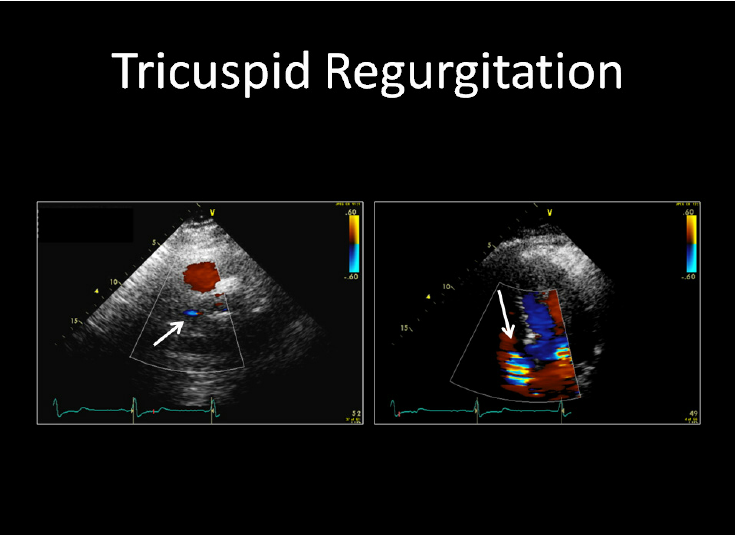
Tricuspid regurgitation is primarily diagnosed using transthoracic echocardiography with color Doppler, which assesses severity, mechanism, right ventricular function, and pulmonary pressures.
❓ What echocardiographic feature indicates severe tricuspid regurgitation?
A dense, early-peaking triangular continuous-wave Doppler jet along with systolic flow reversal in hepatic veins indicates severe tricuspid regurgitation.
❓ What are common symptoms of severe tricuspid regurgitation?
Symptoms include fatigue, peripheral edema, ascites, abdominal fullness, hepatomegaly, and features of right-sided heart failure.
❓ How is functional tricuspid regurgitation managed medically?
Medical management includes diuretics for volume overload and treatment of the underlying cause such as pulmonary hypertension, atrial fibrillation, or left-sided heart disease.
❓ When is surgery indicated in tricuspid regurgitation?
Surgery is indicated in symptomatic severe tricuspid regurgitation, progressive right ventricular dysfunction, or moderate tricuspid regurgitation with annular dilation during left-sided valve surgery.
❓ Which surgical approach is preferred for tricuspid regurgitation?
Tricuspid valve repair with annuloplasty is preferred over valve replacement as it preserves right ventricular function and has fewer long-term complications.